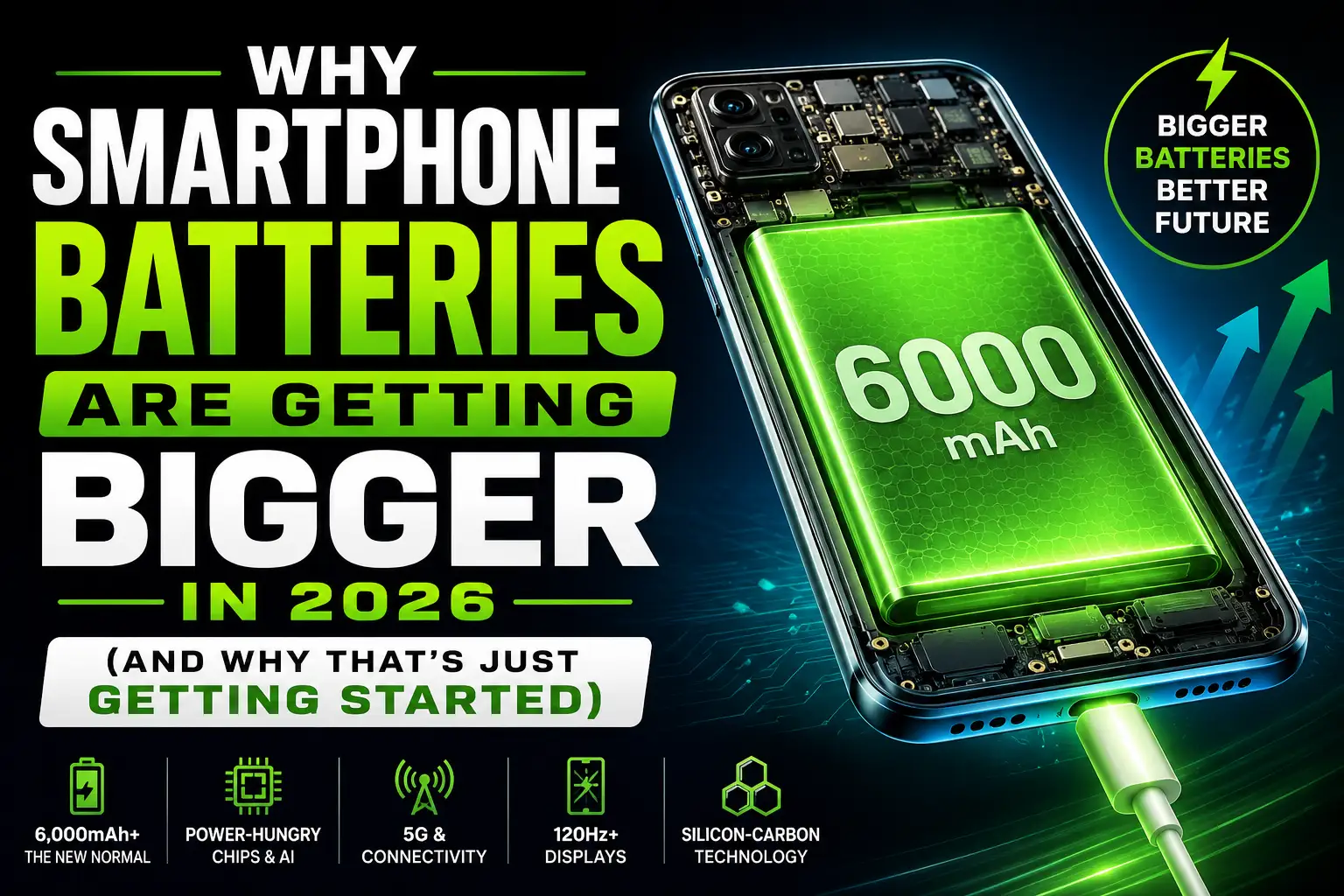
Why Smartphone Batteries Are Getting Bigger in 2026 (And Why That's Just Getting Started)
There was a time when a 3,000mAh battery was considered generous. A few years ago, 4,000mAh became the midrange standard. Today, 5,000mAh is the floor — and phones with 6,000mAh and beyond are moving from niche gaming devices into mainstream flagships. The forces driving this in 2026 are stacking on each other: new battery chemistry, more power-hungry features, AI workloads, and dramatically improved energy density. Here's why phone batteries are bigger now, why they need to be, and where this is heading.
Why 5,000mAh Is No Longer Considered Large
Five years ago, a 5,000mAh battery was the territory of gaming phones and rugged handsets. Today, it ships in entry-level devices from Realme, Motorola, and Samsung's Galaxy A series without anyone raising an eyebrow. The reason comes down to a simultaneous increase in consumption across nearly every smartphone component.
Modern phones power 120Hz or 144Hz AMOLED displays. They push signals through 5G radios that remain less efficient than mature 4G LTE modems. They run camera processing pipelines that would have required a desktop GPU a decade ago. And increasingly, they run on-device AI models that weren't part of the smartphone equation until recently. All of these systems draw from the same battery, and their combined demand has permanently redefined what "adequate" capacity means.
The shift isn't a marketing gimmick — it's a direct response to exponentially growing power consumption across every major subsystem of a modern phone.
The Rise of 6,000mAh and Larger Batteries
In 2026, the 6,000mAh+ battery has completed its migration from gaming phones into mainstream flagships. Xiaomi's high-capacity models, Samsung's Ultra lineup, and offerings from Honor, Vivo, and Oppo have pushed this threshold into the premium tier — made possible by silicon-carbon battery technology that delivers higher energy density without proportionally increasing device size.
Motorola and similar value-focused brands have brought high-capacity batteries down to affordable price points, accelerating the sense that 4,000mAh is simply outdated for anyone using their phone as a primary device.
What Is a Silicon-Carbon Battery and Why Does It Matter?
Traditional lithium-ion batteries use graphite as the anode — the electrode that absorbs lithium ions during charging. Graphite works, but has a ceiling: it can hold only so many lithium ions per unit of volume.
Silicon can store roughly ten times as many lithium ions as graphite, making it far more energy-dense in theory. The long-standing engineering problem is that silicon swells significantly — up to 300% — when it absorbs lithium, cracking the electrode over cycles and degrading the battery quickly. The silicon-carbon composite solution weaves silicon particles into a carbon matrix that flexes with the expansion, preserving cycle life while capturing much of silicon's storage advantage.
The result: a battery that stores more energy in the same physical space — higher energy density without requiring a larger cell. Samsung, Xiaomi, Honor, and Vivo have all adopted silicon-carbon anode technology as manufacturing costs have dropped.
| Feature | Traditional Lithium-Ion (Graphite Anode) | Silicon-Carbon Battery |
|---|---|---|
| Anode material | Graphite | Silicon-carbon composite |
| Energy density | Moderate (~250–300 Wh/L) | Higher (~400+ Wh/L, improving) |
| Ion storage capacity | Lower baseline | Up to 10x greater for silicon |
| Swelling during charging | Minimal | Managed via carbon matrix |
| Long-term durability | Proven, stable | Improving rapidly |
| Commercial adoption | Universal | Growing fast (Samsung, Xiaomi, Honor, Vivo) |
How Phones Can Have Bigger Batteries Without Getting Much Thicker
Phones have gotten thinner as battery capacity has increased — because the explanation lies in energy density rather than cell size. If you can pack more energy into the same volume of material, the cell doesn't need to physically grow. Combined with incremental gains from thinner displays and more efficient chipsets, there's room to raise battery capacity without proportionally increasing thickness or weight.
How AI Is Changing Smartphone Power Consumption
On-device AI features are one of the newest significant contributors to battery drain. Real-time photo enhancement, live transcription, on-device language processing, and AI camera optimization all run on dedicated neural processing units — more efficient than the main CPU, but still drawing continuous power as manufacturers add more AI features.
Apple Intelligence, Google's Pixel AI suite, Samsung Galaxy AI, and equivalents from Xiaomi and others have expanded the category of tasks processed continuously on-device. A phone transcribing a meeting while running background photo AI and a live translation overlay operates under completely different power demands than one checking email.
Pro Tip: Reviewing which AI features run continuously in the background — rather than only on demand — is one of the easiest ways to recover meaningful battery life without buying a new device.
5G and High-Refresh-Rate Displays
5G modems are more efficient than their first generation, but still consume more power than LTE on faster bands. High-refresh-rate displays compound this — a 120Hz AMOLED running at full rate draws meaningfully more power than a 60Hz screen, though adaptive refresh (scaling between 1Hz and 120Hz based on content) has narrowed the gap. Together, these two features represent a near-constant power overhead that phones from earlier generations simply didn't carry.
Why Gaming Smartphones Push Battery Capacity the Hardest
Gaming phones from Asus ROG, Nubia Red Magic, and Xiaomi's Black Shark line carry 6,000–7,000mAh+ batteries because sustained GPU-intensive gaming is among the most demanding workloads a smartphone faces. Peak-brightness screens, active cooling, high-refresh rendering, and audio output for an extended gaming session draw power unlike anything a messaging app creates. Features pioneered here — large batteries, vapor chamber cooling, improved thermal management — have since filtered into mainstream flagships.
Bigger Battery vs Faster Charging: Which Actually Matters More?
| Factor | Larger Battery | Faster Charging |
|---|---|---|
| All-day use without charging | Strong advantage | Moderate |
| Quick recovery from low charge | No advantage | Strong advantage |
| Long-term battery health | Neutral to positive | Depends on thermal management |
| Best for travel / no outlet access | Clear winner | Limited without a charger |
| Best for desk workers near power | Less critical | More practical |
The right choice depends on usage context. For users who travel without reliable charger access, raw capacity wins — a fast charger is useless on a train with no outlet. For desk workers near power, fast charging at 67W+ makes raw capacity less critical. Most premium phones in 2026 offer both, but understanding which matters more for your lifestyle is worth thinking through before choosing a device.
Does a Bigger Battery Always Mean Better Battery Life?
Important: A higher mAh number does not automatically guarantee longer real-world battery life. A 6,000mAh phone with a power-hungry chipset and aggressive background processes can deliver worse daily endurance than a 5,000mAh phone with efficient software management. Battery life is the product of capacity, efficiency, and software — not capacity alone. Apple's iPhones regularly deliver competitive all-day endurance despite smaller mAh ratings than comparable Android flagships, because Apple's silicon and iOS are tightly optimized together.
Why Software Optimization Still Makes or Breaks Battery Life
Manufacturers can ship 6,000mAh phones and still deliver disappointing endurance if the software is mismanaged. Background app activity, poor wakelocks — software triggers that prevent the phone from entering low-power sleep states — and poorly optimized third-party apps drain batteries regardless of physical capacity. This is why the best-performing phones in real-world battery testing are typically those where hardware capacity, processor efficiency, and software management work together rather than compensating for each other.
The Downsides of Larger Smartphone Batteries
- Weight. Budget phones pushing 6,000mAh often cross 200g; some gaming phones exceed 220–230g. This affects one-handed use and extended sessions.
- Charging time. A larger cell takes longer to fill from empty at the same wattage as a smaller one.
- Heat during charging. Charging at high power generates heat — the primary enemy of long-term battery health. More capacity doesn't change this.
- Environmental load. Larger batteries contain more lithium and cobalt, increasing manufacturing and end-of-life costs.
Battery Health and Long-Term Degradation
Modern phones from Samsung, Apple, and Google include battery management software that slows degradation: charging stops short of 100% unless needed, slows overnight to avoid prolonged peak voltage, and manages heat during fast charging. Improved carbon matrix structures in silicon-carbon cells have largely addressed the faster degradation observed in earlier implementations. Avoiding high charging temperatures and not regularly draining to zero have the greatest impact on long-term battery health, regardless of chemistry.
What Smartphone Batteries Could Look Like Next
Solid-state batteries — replacing the liquid electrolyte with a solid material — are the most discussed future direction. They promise higher energy density, faster charging, less heat, and better safety. Toyota and several battery manufacturers have announced solid-state milestones for electric vehicles, and consumer electronics will likely follow as costs come down. In the nearer term, expect continued silicon anode improvements, better thermal management through faster-responding vapor chambers, and smarter software management of AI workloads and modem power states.
Frequently Asked Questions
Why are smartphone batteries getting bigger in 2026?
A convergence of forces is driving the trend: 5G modems, high-refresh-rate displays, on-device AI workloads, and more powerful processors have all increased consumption simultaneously. Silicon-carbon battery technology has enabled higher energy density, making it practical to include larger cells without proportionally increasing device size.
Is a 6,000mAh smartphone battery actually good?
In most cases, yes — a 6,000mAh battery typically supports all-day and sometimes two-day endurance for moderate users. Whether it translates to exceptional battery life depends equally on processor efficiency, display management, and software optimization.
Do bigger phone batteries last longer than smaller ones?
Not automatically. Larger capacity provides a bigger reservoir, but how long it lasts depends on how efficiently the phone consumes it. A well-optimized 5,000mAh device can outlast a poorly managed 6,500mAh phone. Capacity is one input, not the whole equation.
What is a silicon-carbon battery?
A silicon-carbon battery replaces the traditional graphite anode with a silicon-carbon composite. Silicon can store roughly ten times more lithium ions than graphite, resulting in higher energy density. The carbon structure manages silicon's expansion during charging to preserve cycle life.
Does fast charging damage battery health over time?
Modern fast charging systems include thermal management that has significantly reduced degradation concerns. Consistently charging at high temperatures is a bigger risk than speed itself. Avoiding leaving a phone plugged in at 100% overnight has more impact than avoiding fast charging.
Why don't iPhones always have the largest batteries?
Apple prioritizes the combination of capacity, silicon efficiency, and software optimization rather than maximizing the mAh number. Apple's own chip design allows competitive real-world battery life with smaller rated capacities than some Android counterparts through tight hardware-software integration.
Will smartphone batteries keep getting bigger?
Yes, though energy density improvements from better chemistry may become as significant as raw mAh increases. Solid-state batteries — not yet widely in consumer phones — could redefine expectations further out by offering substantially higher density in the same or smaller footprint.
How does 5G affect smartphone battery life?
5G modems consume more power than LTE when actively using faster bands. Efficiency has improved significantly since 5G's first generation, but it remains a meaningful drain in heavy-usage scenarios. Many phones now intelligently switch between 5G and LTE based on actual bandwidth need, which helps reduce idle drain.
Final Verdict
Smartphone batteries are bigger in 2026 because the phones themselves demand more power than ever before. AI features, 5G modems, always-on high-refresh displays, and powerful mobile processors have collectively pushed consumption well past what earlier battery sizes could sustain through a full day. Silicon-carbon technology has answered by increasing the energy density available in a given space, letting manufacturers raise capacity without proportionally growing device thickness or weight. The trend has further to run as on-device AI processing expands and consumer expectations for all-day-plus endurance become the norm rather than a premium feature.
Key Takeaways
- 5,000mAh is now the baseline for mainstream smartphones, not a high-end specification — modern power demands have permanently shifted that floor upward.
- Silicon-carbon batteries store more energy in the same physical space by replacing graphite anodes with a silicon-carbon composite, enabling the current capacity increase without making phones thicker.
- A bigger mAh number alone does not guarantee better battery life — processor efficiency, display management, and software optimization determine real-world endurance alongside raw capacity.
- AI workloads, 5G, and high-refresh-rate displays are the three major new power consumers that have made larger batteries a practical necessity rather than a spec-sheet marketing point.
- Solid-state batteries remain the most significant technology ahead, with the potential to raise energy density further while improving safety and thermal performance.
References
- Samsung – Galaxy S24 Ultra Specifications
- Apple – iPhone Compare (Battery Capacity)
- Google – Pixel Phone Specifications
- Xiaomi – Official Global Site
- GSMArena – Smartphone Specifications Database
- Android Authority – Silicon-Carbon Battery Technology Explained
- Nature – Battery Research Publications
- IEEE Xplore – Silicon-Carbon Anode Research
- Honor – Official Smartphone Lineup
- OnePlus – Official Site
Comments
0 comments
No comments yet
Start the discussion with a thoughtful note.