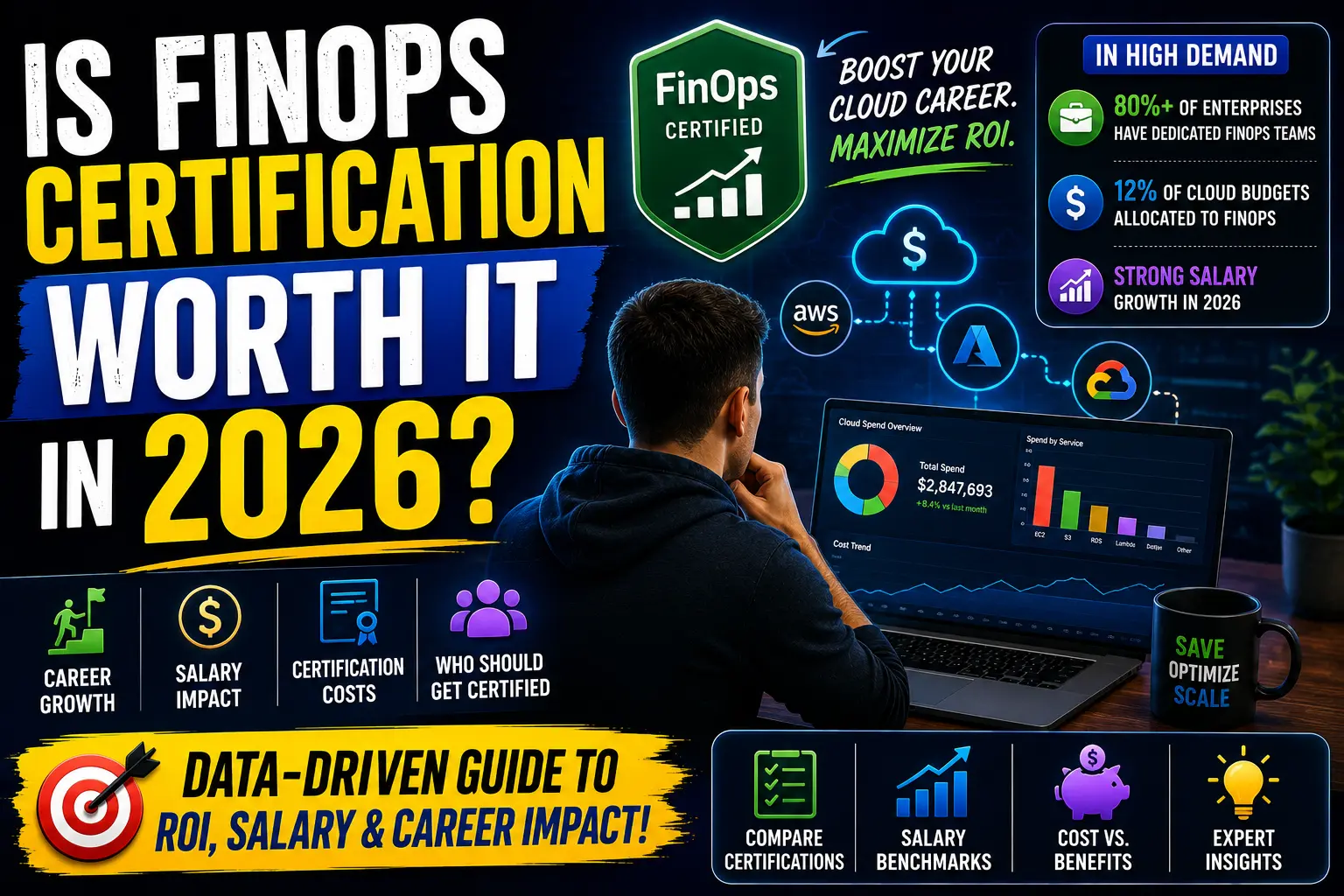
Is FinOps Certification Worth It in 2026? Career ROI, Salary Impact & Who Should Get Certified
A data‑driven analysis of FinOps certification ROI in 2026. Learn about salary impact, career growth, certification costs, employer demand, and whether the credential fits your professional goals.
What Is FinOps and Why It Matters in 2026
FinOps (Financial Operations) is the practice of bringing financial accountability to cloud computing. It blends cloud engineering, finance, and data‑driven decision‑making to optimize cloud spend while maintaining velocity. By 2026, more than 80% of large enterprises are expected to have dedicated FinOps teams (Flexera State of the Cloud Report, 2026) and organizations are allocating an average of 12% of their cloud budget to FinOps initiatives.
Important: FinOps expertise is now a core competency for cloud engineers, DevOps leaders, and finance professionals who manage multi‑cloud environments.
Major FinOps Certifications Overview
The FinOps Foundation is the canonical body behind these credentials, aligning them with the FinOps Framework, FOCUS Specification, and emerging AI‑cost‑management practices.
Benefits of Earning a FinOps Certification
- Salary premium: Certified practitioners earn on average 12‑22% more than non‑certified peers (Flexera 2026 salary survey). For senior engineers, the premium can exceed $45,000 annually.
- Career acceleration: 78% of certified professionals reported a promotion or new role within 12 months of certification.
- Methodology: Certifications teach the three‑phase FinOps lifecycle (Inform, Optimize, Operate) and the six core principles, giving a common language for cross‑functional teams.
- Data‑driven decisions: FOCUS Analyst training enables practitioners to standardize cost tagging and reporting across AWS, Azure, GCP, and OCI, improving measurement accuracy by 30‑40%.
- Market validation: With only ~30,000 certified practitioners worldwide, the credential signals expertise in a talent‑scarce area.
When Certification Is Worth It
The certification pays off in several concrete scenarios:
- You’re a cloud engineer, DevOps specialist, or platform engineer who routinely manages cloud spend and wants to formalize your knowledge.
- Your organization is scaling to multi‑cloud or AI‑driven workloads and needs practitioners who can translate FOCUS data into actionable insights.
- You’re transitioning into a FinOps‑focused role (e.g., Cloud Cost Analyst, FinOps Lead) and need an industry‑recognizable credential.
- Your employer subsidizes certification costs and expects a return on investment through cost‑saving initiatives.
When Certification May Not Be Worth It
Certification isn’t a universal requirement. Consider skipping if:
- You already have proven cost‑optimization results with documented savings > $200K annually, and your resume reflects those achievements.
- Your role is heavily focused on software development or infrastructure automation where FinOps principles are less directly applied.
- Your company does not have a formal FinOps function or budget for certifications.
- You prefer to build expertise through on‑the‑job projects, open‑source contributions, or self‑studied labs rather than a paid exam.
Employer Demand and Hiring Trends (2025‑2026)
FinOps appears in 84% of cloud‑related job descriptions as a preferred or required skill (LinkedIn Jobs, 2026). Companies are quoting an average salary uplift of $15K‑$30K for certified candidates. The demand breakdown by role is:
- Cloud Engineer / DevOps Engineer: 42% of listings mention FinOps knowledge.
- Finance / Procurement Analyst: 38% require or prefer certification.
- Site Reliability Engineer (SRE): 35% list FinOps as a “nice‑to‑have”.
- Finance Leadership (CFO‑level): 27% expect FinOps literacy for strategic cloud budgeting.
Does FinOps Certification Increase Salary?
Empirical data from the Flexera 2026 State of the Cloud Report shows a median base‑salary increase of $12,000 for FOCP holders and $27,000 for FinOps Certified Professionals compared to non‑certified peers in comparable roles.
The uplift is highest in organizations with mature cloud spend management programs (>$500M annual cloud spend), where certification is linked to measurable cost‑optimization outcomes.
How Difficult Is the Exam?
The FinOps Certified Practitioner exam consists of 50 multiple‑choice questions, a 60‑minute open‑book window, and a 75% passing threshold. Most candidates with 1‑2 months of focused study (20‑30 hours total) achieve passing scores. The difficulty stems from the breadth of material—principles, lifecycle phases, personas, and FOCUS fundamentals—rather than technical depth.
Important: You may bring notes into the exam, but you cannot bring full copies of the FinOps Framework; summaries and personal checklists are recommended.
Study Resources & Preparation Tips
- Official Learning Path: Enroll in the free “Introduction to FinOps” module on learn.finops.org, then progress to the paid self‑paced exam bundle (≈$500).
- Framework Deep‑Dive: Download the full FinOps Framework PDF (finops.org/framework) – it is the primary exam source.
- Practice Questions: Use the Foundation’s free sample questions and the “FinOps Community Slack” study channel for peer‑reviewed explanations.
- Hands‑On Lab: Run a cost‑allocation proof‑of‑concept in your own AWS/Azure/GCP sandbox and map findings to the three‑phase lifecycle.
- Community Engagement: Attend a FinOps Foundation virtual meetup; 85% of participants report that real‑world discussions clarified ambiguous exam topics.
- Study Schedule: Allocate 1‑2 hours per weekday over 3‑4 weeks; use flashcards for the six principles and FOCUS terminology.
Common Misconceptions
Several myths persist around FinOps certification:
- “Certification guarantees a job.” In reality, it improves your odds but hiring decisions depend on overall experience, networking, and demonstrated results.
- “Only finance professionals need it.” The certification is designed for engineers, DevOps, SREs, and product managers who manage cloud spend.
- “All certifications are equal.” The Practitioner and Professional tiers have dramatically different expectations and salary impacts.
- “Renewal is automatic.” Renewal requires documented continuing education or contribution to the FinOps community; simply paying the fee does not extend the credential.
Final Verdict
For most cloud‑focused professionals in 2026, a FinOps certification is a high‑ROI investment. It delivers measurable salary lifts, validates a skill set that enterprises increasingly demand, and positions you at the intersection of engineering and finance.
However, the credential should complement—rather than replace—real‑world cost‑optimization results. If you already drive substantial savings, have deep hands‑on experience, or work in an organization that does not value certification, the direct ROI may be limited.
In short: If you manage cloud spend, aspire to lead FinOps initiatives, or want to differentiate yourself in a competitive market, getting certified is likely worth the investment.
Key Takeaways
- FinOps certification ROI is among the highest of any cloud‑related credential in 2026.
- Salary premiums range from 12% to 25% depending on role and seniority.
- Certifications are most valuable when paired with documented cost‑saving outcomes.
- The FinOps Foundation’s three‑tier pathway (Practitioner → Engineer → Professional) aligns with career progression.
- Hands‑on experience and community involvement outweigh the exam cost alone.
- Consider the certification as part of a broader professional development strategy—combine it with practical projects and networking for maximum impact.
References
- FinOps Foundation: https://www.finops.org
- FinOps Foundation Learning Portal: https://learn.finops.org
- Flexera State of the Cloud Report 2026: https://www.flexera.com/www/research/state-of-the-cloud-report
- Linux Foundation Training – FinOps Courses: https://training.linuxfoundation.org/training-categories/finops
- Gartner Market Overview: Cloud Financial Management (2025‑2026): https://www.gartner.com/en/documents/4017742
- Flexera 2026 Cloud Spend Management Survey: https://www.flexera.com/www/solutions/cloud-spend-management
- Microsoft Azure Well‑Architected Framework – Cost Management: https://learn.microsoft.com/en-us/azure/architecture/well-architected/cost-management/
- AWS Cost Optimization Documentation: https://docs.aws.amazon.com/cost-optimization/index.html
- Google Cloud Cost Management & Optimization Guide: https://cloud.google.com/docs/cost-management
- Flexera 2026 Salary Survey (Cloud Professional): https://www.flexera.com/www/survey/cloud-professional-salary
- LinkedIn Jobs Analytics – FinOps Keywords (2026): https://www.linkedin.com/jobs/search/?keywords=FinOps
Comments
0 comments
No comments yet
Start the discussion with a thoughtful note.