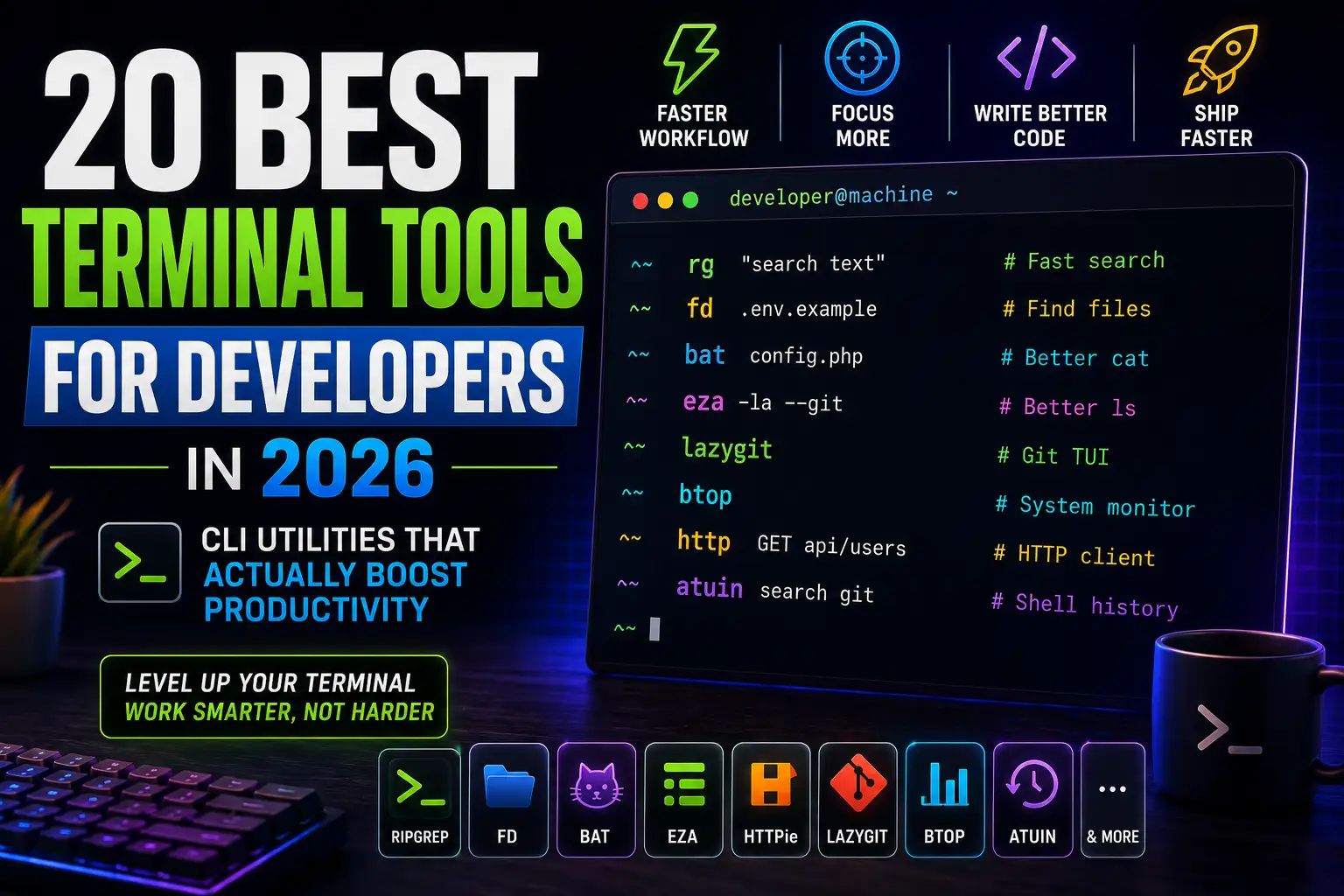
20 Best Terminal Tools for Developers in 2026: CLI Utilities That Actually Boost Productivity
The terminal never went away. It got better. While graphical interfaces matured, a quieter revolution happened in the command line: Rust-powered, actively maintained CLI tools replaced aging Unix utilities with faster, smarter, developer-friendly alternatives. Tools like ripgrep, bat, and fzf are fixtures in the daily workflows of frontend and backend developers, DevOps engineers, and open-source contributors across every major stack. This guide covers 20 of the best in 2026: what each one does, why it earns a place in your setup, and how to install and use it immediately.
Why Terminal Productivity Still Matters in 2026
GUI tools handle a lot, but the terminal remains the most direct path between a developer and their system. Shell scripts automate deployment pipelines. SSH sessions run on servers with no desktop environment. Docker, Kubernetes, Git, and most build tools are fundamentally command-line first. Optimizing your terminal setup isn't about nostalgia for older workflows — it's about spending less time on mechanics and more time on thinking. Replacing five slow traditional commands with five faster modern alternatives compounds across hundreds of interactions every day.
Modern CLI Tools vs Traditional Unix Commands
| Traditional Tool | Modern Replacement | Key Improvement |
|---|---|---|
cat | bat | Syntax highlighting, line numbers, Git integration |
ls | eza | Icons, Git status, color-coded permissions |
find | fd | Faster, simpler syntax, respects .gitignore |
grep | ripgrep (rg) | Dramatically faster, Unicode aware, .gitignore aware |
curl | httpie / xh | Human-readable output, JSON by default |
htop | btop / bottom | Mouse support, richer graphs, GPU monitoring |
du | dust | Sorted visual output, no flags needed |
git CLI | lazygit | Interactive TUI, stage hunks, manage branches visually |
git diff | delta | Syntax-highlighted diffs with side-by-side view |
| Manual history search | atuin | Encrypted shell history with full-text sync across machines |
The 20 Best Terminal Tools for Developers in 2026
1. bat — A Better cat
What it does: Displays file contents with syntax highlighting, line numbers, Git change indicators, and automatic paging for long files.
Why developers love it: Reading a configuration file, a PHP controller, or a Vue component in cat output is a wall of unstyled text. bat renders it like a miniature code editor directly in the terminal.
brew install bat          # macOS
apt install bat           # Debian/Ubuntu
winget install sharkdp.bat  # Windows

bat src/controllers/UserController.php
bat --diff config/app.php  # show only changed lines
Limitation: For piping into other commands, fall back to cat — bat's ANSI codes can interfere with downstream processing.
2. eza — A Modern ls
What it does: Lists directory contents with color-coded file types, icons, Git status indicators, and a tree view built in.
Why developers love it: A single eza -la --git in a Node.js project shows every file, its permissions, its size, and its current Git status without running a separate git status.
brew install eza
apt install eza

eza -la
eza --tree --level=2 src/
eza -la --git
3. fd — A Better find
What it does: Finds files and directories with a simpler syntax than find, automatically respecting .gitignore and hidden file rules.
Why developers love it: Finding all .env.example files across a monorepo or all Vue component files in a large project requires no flags — just the search term.
brew install fd
apt install fd-find       # Linux (binary: fdfind)
winget install sharkdp.fd

fd .env.example
fd -e vue src/
fd -e log --exec rm {}   # delete all .log files
Pro Tip: Combine fd with fzf for interactive fuzzy file picking in any project.
4. ripgrep (rg) — A Better grep
What it does: Searches file contents recursively with dramatically faster performance than grep, automatic .gitignore support, and Unicode awareness.
Why developers love it: Searching a full Laravel codebase — including Blade templates, PHP controllers, and config files — for a function name or string takes milliseconds rather than seconds. VS Code uses ripgrep internally for its own search.
brew install ripgrep
apt install ripgrep
winget install BurntSushi.ripgrep.MSVC

rg "getUserById"
rg -t php "Auth::user"
rg -l "TODO" src/
5. fzf — Fuzzy Finder
What it does: A general-purpose interactive fuzzy finder that integrates with your shell, fd, ripgrep, Git, and almost any other command that produces list output.
Why developers love it: fzf transforms any terminal list into an interactive, searchable picker. Press Ctrl+R to fuzzy-search shell history. Use it to interactively select a Git branch, a Docker container, or a file to open in vim.
brew install fzf
apt install fzf
$(fzf --preview 'bat --color=always {}')  # preview with bat

git branch | fzf | xargs git switch       # interactive branch switch
docker ps | fzf                            # fuzzy pick a container
6. zoxide — Smarter cd
What it does: Learns which directories you visit most often and lets you jump to any of them with a few characters, regardless of current location.
Why developers love it: Switching between a frontend project, a backend API, and an infrastructure folder dozens of times a day is friction that adds up. z project-name jumps to the right place instantly.
brew install zoxide
winget install ajeetdsouza.zoxide

# Add to .bashrc / .zshrc:
eval "$(zoxide init zsh)"

z my-laravel-project
z react-app
7. lazygit — Terminal Git UI
What it does: A full-featured terminal UI for Git that lets you stage individual file hunks, manage branches, resolve conflicts, view diffs, cherry-pick, and interact with remotes — all from a single keyboard-driven interface.
Why developers love it: Staging partial changes — adding only the bug fix from a file that also contains unfinished work — is tedious with raw git add -p. In lazygit, you highlight hunks and press Space.
brew install lazygit
winget install JesseDuffield.lazygit

lazygit
Best Pick: lazygit is the single highest-productivity Git tool on this list for developers who use the terminal daily. It removes the friction of staging, branching, and rebasing without requiring a GUI application.
8. delta — Better Git Diffs
What it does: A syntax-highlighted, side-by-side diff viewer for Git that replaces the default diff output with something genuinely readable.
brew install git-delta
cargo install git-delta

# Add to ~/.gitconfig:
[core]
    pager = delta
[delta]
    side-by-side = true
    line-numbers = true
9. ripgrep + btop — System Monitoring
9. btop — Better System Monitor
What it does: A resource monitor with a rich terminal UI showing CPU, memory, disk, network, and process statistics in real time, with full mouse support.
brew install btop
apt install btop
winget install aristocratos.btop4win

btop
Why it beats htop: GPU monitoring, mouse interaction, themes, and more informative graphs without requiring extra plugins.
10. bottom (btm) — Lightweight Monitor
What it does: A lighter-weight system monitor written in Rust, ideal for remote SSH sessions on servers with minimal resource overhead.
brew install bottom
cargo install bottom
winget install Clement.bottom

btm
11. dust — Better du
What it does: Shows disk usage sorted visually, making it immediately obvious which directories are consuming the most space without any flags or sorting pipes.
brew install dust
cargo install du-dust

dust
dust -n 20 /var/log
Productivity Hack: Run dust in a Docker build context or a Laravel project root to instantly see which folders are bloating your image or deployment package.
12. httpie — Human-Friendly HTTP Client
What it does: A command-line HTTP client that sends requests with a clean syntax, formats JSON responses automatically, and displays colored output — far more readable than raw curl for API development.
brew install httpie
pip install httpie
winget install HTTPie.HTTPie

http GET https://api.example.com/users
http POST https://api.example.com/users name="Jane" role="admin"
http --auth user:pass GET https://api.example.com/orders
13. xh — Faster httpie Alternative
What it does: A Rust-based HTTP client with near-identical syntax to httpie but significantly faster startup and execution — better for scripts where speed matters.
brew install xh
cargo install xh

xh GET https://api.example.com/products
xh POST https://api.example.com/orders id=42 qty=3
14. jq — JSON Processor
What it does: A lightweight command-line JSON processor that filters, transforms, and formats JSON — essential for working with API responses, Docker inspect output, and GitHub Actions payloads.
brew install jq
apt install jq
winget install jqlang.jq

curl -s https://api.example.com/users | jq '.[].name'
cat response.json | jq '.data | .[] | {id, email}'
docker inspect container_name | jq '.[0].NetworkSettings.IPAddress'
Expert Recommendation: Learn jq before any other data tool on this list. The ability to pipe API responses directly into readable, filtered output eliminates an entire category of copy-paste debugging.
15. yq — YAML Processor
What it does: The YAML counterpart to jq — reads, filters, transforms, and writes YAML, JSON, and TOML files with the same query-style syntax.
brew install yq
winget install MikeFarah.yq

yq '.services.web.image' docker-compose.yml
yq -i '.version = "2.1"' docker-compose.yml
Essential for Kubernetes manifest management and Docker Compose automation in DevOps workflows.
16. tldr — Simplified Man Pages
What it does: Shows community-maintained, practical examples for hundreds of CLI commands — the pages you wished man showed instead of full specification text.
brew install tldr
npm install -g tldr

tldr tar
tldr docker
tldr git rebase
17. starship — Cross-Shell Prompt
What it does: A fast, highly configurable cross-shell prompt that shows the current Git branch, Node version, Python version, Docker context, Kubernetes namespace, and more — automatically, in whichever shell you use.
brew install starship
winget install Starship.Starship

# Add to end of ~/.zshrc or ~/.bashrc:
eval "$(starship init zsh)"
eval "$(starship init bash)"
Performance Tip: Starship is written in Rust and adds under 5ms to prompt render time even with many modules active — faster than most pure-shell prompt frameworks like Oh My Zsh themes.
18. atuin — Shell History on Steroids
What it does: Replaces shell history with a searchable, filterable, encrypted database that syncs across machines, shows exit codes, and records timestamps and working directories alongside every command.
brew install atuin
bash <(curl https://raw.githubusercontent.com/atuinsh/atuin/main/install.sh)

# Ctrl+R now opens atuin's interactive search
atuin search docker
atuin stats
Important Note: Atuin's sync server is end-to-end encrypted — your history is never stored in plaintext on their servers, and self-hosting is also an option.
19. direnv — Directory-Scoped Environment Variables
What it does: Automatically loads and unloads environment variables from .envrc files when you enter or leave a directory — keeping per-project environment variables clean without polluting your global shell.
brew install direnv
apt install direnv

# Add to ~/.zshrc:
eval "$(direnv hook zsh)"

# In project directory:
echo 'export NODE_ENV=development' > .envrc
direnv allow
Invaluable when working across multiple Laravel projects, each with different APP_ENV, DATABASE_URL, or API key configurations.
20. hyperfine — Command Benchmarking
What it does: Benchmarks CLI commands with multiple runs, warmup iterations, and statistical output — useful for comparing build tools, measuring script performance, or deciding between two implementation approaches.
brew install hyperfine
cargo install hyperfine

hyperfine 'npm run build' 'pnpm run build'
hyperfine --warmup 3 'rg "TODO" src/' 'grep -r "TODO" src/'
Best Tool Combinations for Maximum Productivity
| Workflow | Recommended Stack |
|---|---|
| Daily file navigation | eza + fd + fzf + zoxide |
| Code search | ripgrep + fzf + bat (preview) |
| Git workflow | lazygit + delta + atuin |
| API development | httpie or xh + jq + yq |
| System monitoring | btop + dust + bottom (SSH) |
| Shell experience | starship + atuin + direnv + tldr |
| DevOps / Kubernetes | jq + yq + xh + direnv + hyperfine |
Recommended Terminal Setup for Modern Development
A complete, productivity-optimized terminal setup in 2026: Starship for the prompt, atuin for history, zoxide for navigation, direnv for environment isolation, eza aliased to ls, bat aliased to cat, fd and ripgrep for search, lazygit for Git, and jq plus httpie for API work. That covers 95% of daily terminal interactions with meaningfully better tools than the defaults.
# ~/.zshrc recommended aliases
alias ls='eza -la --git'
alias cat='bat'
alias find='fd'
alias grep='rg'
alias du='dust'
alias top='btop'
eval "$(zoxide init zsh)"
eval "$(starship init zsh)"
eval "$(direnv hook zsh)"
Important Note: Alias overrides like alias cat='bat' can occasionally break scripts expecting raw cat behaviour. In CI/CD environments, use the full binary paths rather than relying on shell aliases.
Frequently Asked Questions
Do these tools work on Windows?
Most do. The majority are cross-platform Rust binaries available via winget, Scoop, or Chocolatey on Windows. Tools that rely on shell integration (zoxide, direnv, atuin) work in PowerShell, Git Bash, or WSL2 — WSL2 gives the most complete experience.
Which tools should a beginner install first?
Start with bat, eza, ripgrep, tldr, and starship. They require zero configuration to see immediate value and teach good terminal habits before adding more complexity.
Do any of these tools conflict with each other?
No. They are all independent binaries. Shell aliases that override default commands (alias cat='bat') are the only area where care is needed — keep the originals accessible for scripts that depend on classic behaviour.
Is Homebrew the best way to install on macOS?
For macOS, Homebrew is the most straightforward package manager for this list. All 20 tools have Homebrew formulae. On Linux, apt or cargo works for most; on Windows, winget or Scoop covers the majority.
How do I keep all these tools updated?
Run brew upgrade on macOS, apt upgrade on Debian/Ubuntu, or cargo install-update -a (with cargo-update) for Rust-installed tools. Most tools also support update checks via their own --version commands.
Final Verdict
The tools on this list are actively maintained, widely adopted, and measurably faster than the utilities they replace. None require abandoning your existing workflow — each one slots in as a drop-in upgrade or an alias away. Start with the five that solve the most friction in your current setup and build from there. Within a week, the old defaults will feel like working without autocomplete.
Key Takeaways
- ripgrep and fd are the two highest-impact replacements for classic Unix search tools — faster, smarter, and gitignore-aware by default.
- lazygit is the single best Git productivity upgrade available without switching to a GUI application.
- jq is essential for any developer working with APIs, Docker, Kubernetes, or GitHub Actions output.
- fzf multiplies the value of every other tool on this list by making their output interactively searchable.
- starship + atuin + direnv form a foundational shell setup that dramatically reduces context-switching overhead across multiple projects.
- Most tools on this list are Rust-binaries with near-zero startup overhead — installing them does not slow your terminal down.
References
- bat – GitHub Repository
- eza – GitHub Repository
- fd – GitHub Repository
- ripgrep – GitHub Repository
- fzf – GitHub Repository
- zoxide – GitHub Repository
- lazygit – GitHub Repository
- delta – GitHub Repository
- btop – GitHub Repository
- bottom (btm) – GitHub Repository
- dust – GitHub Repository
- HTTPie – Official Documentation
- xh – GitHub Repository
- jq – Official Documentation
- yq – GitHub Repository
- tldr pages – Official Site
- Starship – Official Documentation
- atuin – Official Site
- direnv – Official Documentation
- hyperfine – GitHub Repository
- Homebrew – Official Site (macOS/Linux)
- winget – Microsoft Documentation
Comments
0 comments
No comments yet
Start the discussion with a thoughtful note.