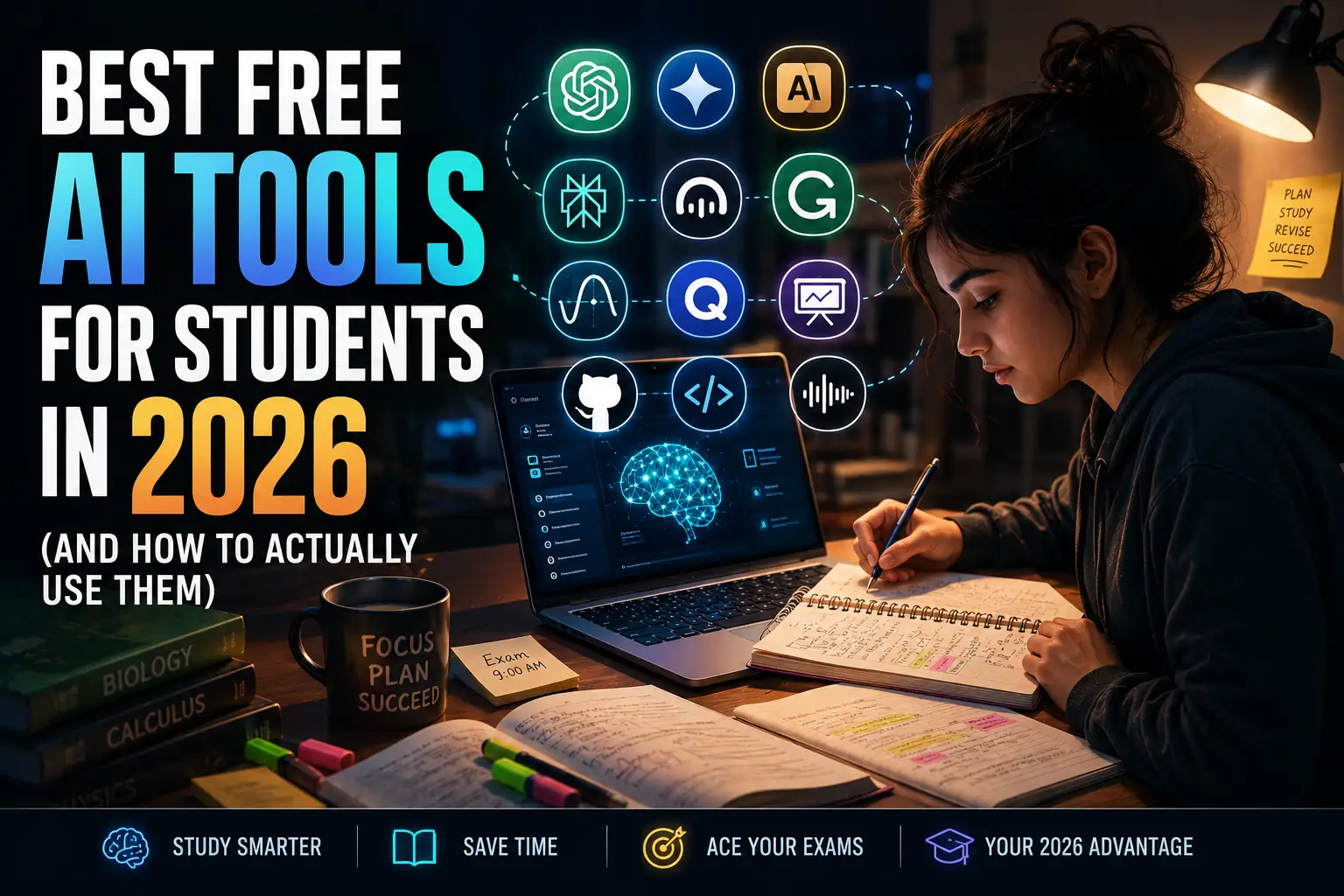
Best Free AI Tools for Students in 2026 (And How to Actually Use Them)
Picture a university student named Aisha. It's 11:40 p.m. on a Tuesday, her critical biology exam is looming at 9 a.m., and her study notes look less like an academic resource and more like a chaotic crime scene. They are half-typed, half-handwritten, and covered in three different colours of highlighter that meant something incredibly important three weeks ago, but mean absolutely nothing to her now. Two years ago, her only realistic options in this scenario were excessive caffeine, a frantic all-nighter, and sheer panic.
Tonight, however, the story is entirely different. She opens a new browser tab, uploads her messy notes, and asks a targeted question. Twenty minutes later, instead of a breakdown, she has a neatly organized study guide, a practice quiz tailored to her weak spots, and something miraculously close to calm.
That's the authentic, everyday reality of AI in 2026. It's not the sensationalized image of rogue robots writing entire dissertations for lazy students—that's just a lazy clickbait headline. The real story is much quieter, yet infinitely more powerful: thousands of students like Aisha turning midnight chaos into actionable structure, completely for free.
The Problem Isn't Access. It's Aim.
So here is the fundamental question worth sitting with for a second: if these incredible tools are free and widely available, why are so many students still using them so terribly? The answer is simple. Mostly because nobody bothered to hand them a map.
Here is a fitting analogy. Giving a stressed student access to ChatGPT without any strategic guidance is essentially like handing someone a Swiss Army knife and telling them to "go build a house." Is it technically possible to cut a piece of wood with it? Sure. Is it practically chaotic and horribly inefficient? Absolutely. The knife itself isn't the problem—the total lack of a blueprint is.
Most free AI platforms designed for students aren't actually one single, magical tool. They are a diverse toolkit. Each individual piece is exceptionally good at one specific job, and completely mediocre at the rest. The students pulling ahead in 2026 aren't the ones paying for premium subscriptions—they're the ones matching the right tool to the right task. Let's build that blueprint for you, piece by piece, so you can build your ultimate academic stack.
The Generalists: Your First Line of Defense
Every toolkit desperately needs a reliable default—the dependable friend you call when you don't even know what kind of help you actually need yet. For the vast majority of students, that default is ChatGPT. It is the one versatile tool that seamlessly flexes across brainstorming essay topics, explaining a dense macroeconomic concept like you're five, debugging Python code, or gracefully rewriting a clumsy email to your professor. Its free plan remains genuinely usable for casual, everyday studying, though heavy daily reliance can occasionally bump into usage limits.
Gemini earns its prominent spot on this list for a completely different reason: frictionless convenience. If your academic life already lives entirely inside the Google ecosystem—Docs, Gmail, and Drive—Gemini meets you exactly where you are instead of forcing you to leave your workflow. Furthermore, there is a quietly excellent deal currently hiding in plain sight. Students equipped with a valid .edu email address can often verify their status in under a minute through platforms like SheerID. This quick step can unlock a powerful bundle that, in eligible regions, includes a full year of Gemini's top-tier advanced model, Deep Research capabilities, and extra cloud storage, completely free of charge.
Claude, meanwhile, is the tool most students mistakenly reach for last—and they absolutely shouldn't. Across academic circles, it is widely considered the strongest free option for the actual mechanics of writing: structuring a complex essay, tightening a persuasive argument, and meticulously following a tricky formatting rule without completely losing the thread of the narrative. Think of Claude as the brilliant peer editor who reads your rough draft and says, "I see exactly what you're trying to say here—now, here is how to actually say it effectively."
Imagine Marcus, a university sophomore, staring blankly at a 2,000-word public policy essay due in exactly 12 hours. Currently, his document consists of four wildly disconnected paragraphs and a vague "vibe." Marcus doesn't need a brand new idea; he needs logical structure and flow. That is inherently a Claude problem, not a ChatGPT problem. Knowing the difference between the two instantly saves him an hour of agonizing over a blinking cursor.
The Research Partners: Real Citations, Not AI Guesses
Here is a cold, sinking fear every modern student has felt: you passionately build an entire essay paragraph around a compelling fact, only to realize the fact is entirely fabricated. Early AI tools used to make this nightmare worse by confidently inventing credible-sounding sources that simply didn't exist. In 2026, the definitive fix for this issue has a name: Perplexity, especially when you toggle its dedicated "Academic" mode on.
Instead of endlessly trawling unverified random blogs, Perplexity leans heavily on peer-reviewed research papers, verified journals, and trusted university sources. More importantly, it meticulously attaches a clickable citation to nearly every single claim it makes. One critical catch always worth remembering, however: a citation attached to a sentence doesn't automatically make that sentence gospel truth. You still need to click the link and read the actual source. Developing that habit is the exact dividing line between successfully utilizing AI and quietly outsourcing your critical thinking skills to a machine.
Then there is NotebookLM, which is arguably the most fiercely underrated tool on this entire list. With this tool, you upload your actual lecture slides, specific PDFs, and assigned class readings. NotebookLM then builds a custom, walled-off assistant that can only answer questions derived from those exact sources. It offers zero outside guessing and absolutely no hallucinated theories. The free tier remains incredibly generous: allowing up to 100 distinct notebooks, 50 large sources each, and roughly half a million words per notebook. It can even transform a dense, impenetrable 40-page research paper into an engaging, podcast-style audio conversation between two AI hosts. This is genuinely a lifesaver if you happen to learn better by actively listening on a campus walk rather than painfully re-reading a PDF for the fourth consecutive time.
The Student Entrepreneur: Building Your Digital Presence
While managing intense academic workloads, a massive wave of students in 2026 are also running side hustles, building digital portfolios, launching startups, or diving headfirst into freelance digital marketing. If you are building a website or a blog to showcase your projects to future employers, you will quickly realize that creating great content is only half the battle. Getting that content actually seen by search engines like Google is the other half. If you've ever found yourself frustrated, asking why aren't my backlinks getting indexed, know that you are not alone in this struggle. Figuring out SEO mechanics can feel daunting for a student, but much like using AI for your core studies, it is entirely about having the right strategic approach. For those managing a strict, ramen-noodle student budget while trying to aggressively rank their side-project, researching the best backlink indexing tools for small businesses on a budget in 2026 is an incredibly smart move. And if you are still on the fence, wondering if it is even worth the time and effort away from your studies—do I really need a backlink indexing service: the brutal truth for 2026 breaks down exactly when it makes sense to invest your energy, and when you can safely skip it.
The Writing Coach: A Much-Needed Second Pair of Eyes
Grammarly still fiercely earns its established place as your digital second reader. It excels at catching the glaring comma splice you were far too exhausted to notice at 2 a.m., and it brilliantly flags sentences that have hopelessly wandered off mid-thought. The robust free plan covers all the core grammar, spelling, and baseline clarity checks, with a highly useful capped number of AI-assisted, full-sentence rewrites layered on top.
I have one incredibly honest warning here, though: do not let any AI writing tool systematically sand the human personality out of your sentences. Sometimes a sentence feels slightly awkward because it is grammatically broken. But sometimes, a sentence reads as awkward simply because it sounds uniquely like you. Your personal voice and distinct perspective are immensely valuable assets worth protecting, not "fixing" into generic corporate speak.
The Quant Tutor: Always Showing Its Work
In the world of STEM, word problems can easily lie to you. Mathematical equations, however, do not. Wolfram Alpha remains the undisputed champion tool for physics, organic chemistry, and advanced calculus. Why? Because it categorically refuses to just spit out a final, raw answer. Instead, it meticulously walks you through the exact logical steps, mimicking the approach a highly patient human tutor would take. It circles back to explicitly show you exactly where a crucial mathematical sign flipped, or where a vital term accidentally got dropped during integration. For engineering and mathematics students, tracing that clear, step-by-step logic trail is frequently far more valuable than simply possessing the final numerical output.
The Memory Builder: Repetition Without the Mind-Numbing Boredom
Cramming the night before an exam is a desperate sprint. Genuine, long-term learning, on the other hand, is much closer to consistently watering a plant—it requires small, repeated bursts of dedicated attention distributed over time. Quizlet’s latest AI features brilliantly allow you to paste in a wall of deeply messy, unformatted lecture notes and instantly receive a highly structured flashcard set out the other end. This process is free, and it seamlessly integrates with their unlimited manual flashcard creation and scientifically backed spaced-repetition study modes. Using Quizlet won't entirely replace the hard work of initially understanding complex material, but it will quietly and effectively solve the dreadful "I definitely recognized that concept but simply couldn't recall it" problem that ruins so many exam days.
The Presentation Builders: Looking Polished, Not Half-Baked
There is a highly specific, deeply unpleasant kind of existential dread that stems from staring at a completely blank presentation slide at 1 a.m. the night before a major group project is due. Thankfully, powerful visual tools like Gamma and the built-in AI generation features within Canva can magically transform a hastily typed, rough text outline into a clean, highly presentable, and visually striking slide deck in mere minutes. They completely solve the "this looks unfinished and unprofessional" problem, allowing you to wisely spend your limited remaining energy practicing what you are actually going to say to the class, rather than nudging text boxes around a screen.
The Coding Companions: A Patient Pair Programmer
For computer science majors and aspiring developers, GitHub Copilot's free individual tier provides a highly capped but genuinely transformative taste of modern AI-assisted coding. It grants you a few thousand code completions and dozens of targeted chat messages every month—which is more than enough volume to thoroughly learn the exact same digital workflow that professional software engineers utilize daily. Alternatively, AskCodi plays a highly similar, invaluable role specifically for junior programming students who desperately want plain-language, jargon-free explanations of exactly why their specific block of code broke, rather than just blindly copy-pasting a quick fix without learning from the error.
The Quiet Helpers: When Reading Itself Isn't the Core Problem
It's vital to recognize that not every student struggles with absorbing the actual information. Many simply struggle with the rigid format that information arrives in. Picture Daniel, a bright student who can easily absorb and master an hour-long, highly technical lecture just fine if he hears it spoken twice, but who finds his eyes going glassy and unfocused when he tries rereading the exact same dense paragraph of a required textbook for the third consecutive time. For Daniel, the critical bottleneck to his academic success was never a lack of intelligence or dedication—it was entirely a formatting issue.
This is precisely where incredibly useful accessibility tools like Otter.ai (excellent for turning fast-paced live lectures into highly accurate, easily searchable text transcripts) and Speechify (perfect for seamlessly turning dense, heavy reading assignments into high-quality audio you can easily absorb on a walk, a long bus commute, or while washing the dishes) quietly and powerfully change the educational game. Neither of these specific tools makes you inherently smarter. They simply remove an abrasive learning format that was actively working against your brain's natural wiring, and replace it with a format that actually works for you. If you have ever felt like the academic material was perfectly clear but the professor's delivery method simply wasn't connecting, this is the first fix genuinely worth trying before you automatically assume the subject itself is your weakness.
The One Golden Rule That Actually Matters
Imagine handing an advanced graphing calculator to a young student who has never actually been taught how to add or subtract. That expensive calculator won't magically teach them foundational math—it will merely serve to hide the glaring fact that they never learned the basics, right up until the exact terrifying moment they enter a testing room where calculators aren't allowed. Educational AI works in the exact same fundamental way.
Frantically using AI three days before a massive final exam as a desperate substitute for actual studying will absolutely not save your grade. However, if you utilize it consistently from week one of the semester as a personalized tutor—having it explain difficult concepts, relentlessly quizzing you, and systematically organizing your scattered thoughts—it rapidly becomes the single biggest quiet advantage any student can possibly possess. It is the exact same tool, but it yields a completely different, infinitely better outcome. The critical difference lies entirely in exactly when and why you reach for the tool, not merely whether you use it at all.
A Quick, Brutal Feedback Loop (Run This Before You Build Your Stack)
Before you enthusiastically bookmark five shiny new tabs and create a dozen new accounts, I highly recommend running this simple, 30-second gut-check. It will profoundly save you from becoming that chronically overwhelmed student who possesses twelve different high-end AI apps but zero actual functional study systems:
- Relevance: Does this specific AI tool genuinely solve a pressing problem I actually have this week, or am I just aimlessly adding it to my browser because it looked visually impressive in a viral TikTok video?
- Readability: Did the detailed explanation this tool just generated for me actually make the underlying topic clearer in my mind, or did it merely make the topic significantly longer and more convoluted to read?
- Impact: If I completely deleted my account for this tool tomorrow morning, would my daily studying process get measurably harder and more frustrating, or would I honestly barely even notice its absence?
If any given tool fails two out of those three critical questions, instantly close the tab and walk away. Successful digital toolkits work brilliantly because they are intentionally small, highly curated, and perfectly matched to your specific needs—not because they are bloated and full to the brim.
The Real Takeaway
At the end of the day, none of this incredible technology is actually about completely replacing human thinking. It is entirely about ruthlessly removing the painful friction that surrounds human thinking—the terrifying paralysis of the blank page, the utter uselessness of wildly disorganized notes, the suspicious citation you can't properly verify, or the complex mathematical equation where you just can't quite see the transitional steps.
Going back to our story: Aisha didn't confidently pass her morning biology exam because an advanced AI algorithm secretly wrote all of her answers for her. She passed her exam because, at exactly 11:40 p.m., something finally intervened and turned her overwhelming mess of anxiety into a clear, structured map she could actually follow toward success.
That is the ultimate closing lesson to remember here. The very best free AI tools for students in 2026 are not designed to be lazy shortcuts to bypass learning. They are designed to be incredibly clear maps that help you turn profound confusion into practical knowledge you can actually use to win.
Comments
0 comments
No comments yet
Start the discussion with a thoughtful note.