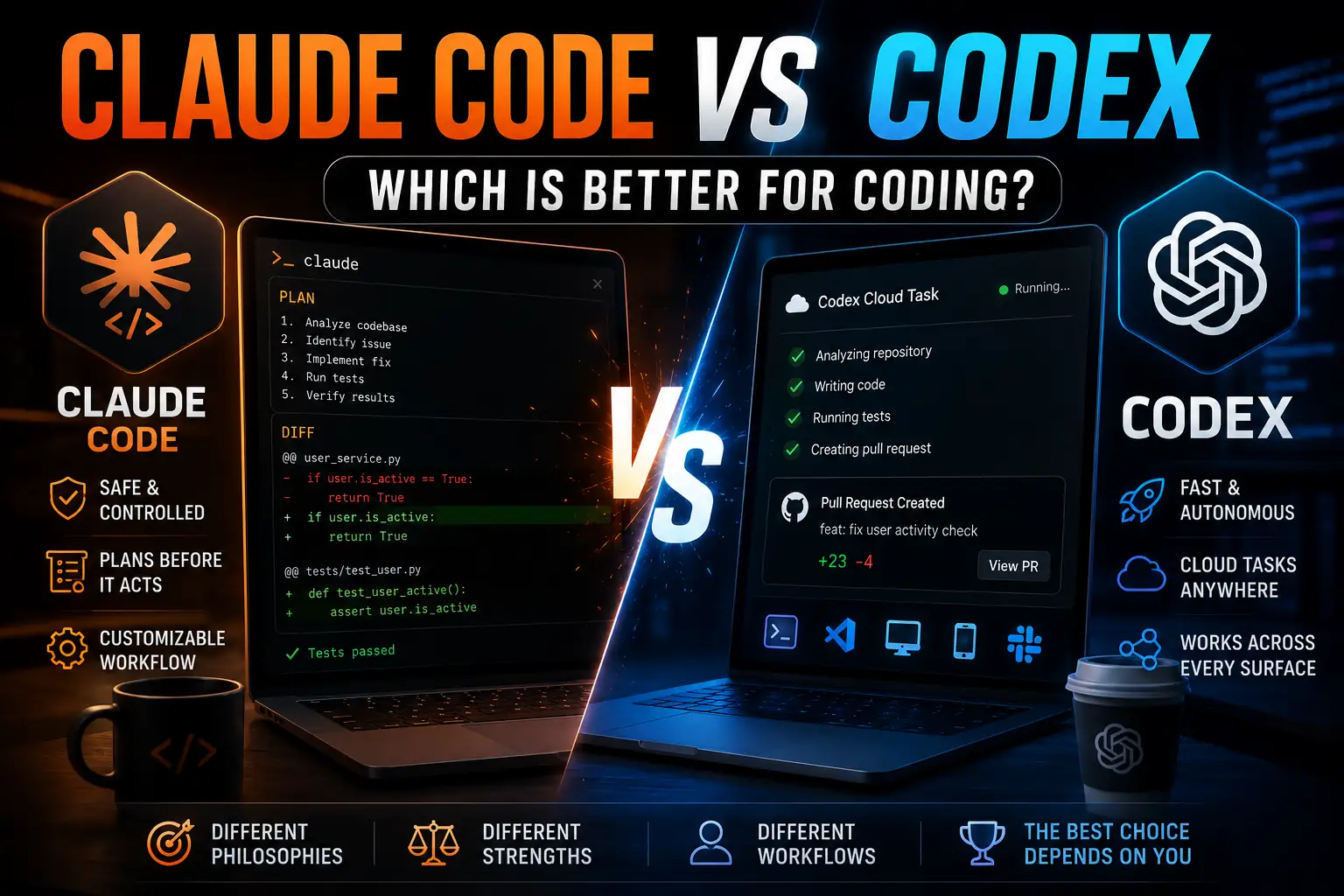
Claude Code vs Codex for Coding: Which Is Better?
Picture a developer named Priya. It's 9 p.m., she has a flaky integration test that's been red for two weeks, three open feature branches, and a release cut on Monday morning. She opens her terminal, types one sentence describing the bug, and watches an AI agent read her entire repo, write a fix, run the test suite, and hand back a diff for her to review. She didn't write a single line herself. She just made the decisions.
That's not science fiction anymore. That's Tuesday for a growing number of engineers. The two tools doing most of that work right now are Claude Code, built by Anthropic, and Codex, built by OpenAI. And if you've spent any time in developer Slack channels lately, you've probably seen the same debate on repeat: which one is actually better?
Here's the honest answer before we go any further: "better" is the wrong question. The right question is better at what, for whom, working how. Let's get into why.
Two Tools, Two Philosophies
Think of Claude Code and Codex as two different kinds of contractors you could hire to renovate your house. One shows up, asks clarifying questions, shows you a blueprint before touching a wall, and waits for your sign-off at each stage. The other can also work that way — but it's built to disappear for a weekend and come back with the whole kitchen redone, checking in only when something genuinely needs your judgment. Neither approach is wrong. They just suit different homeowners.
Claude Code is Anthropic's agentic coding tool. It lives in your terminal, but it also runs inside VS Code, JetBrains IDEs, a standalone desktop app, and even a browser-based version at claude.ai/code for kicking off tasks from your phone. It reads your full codebase, plans an approach across multiple files, edits code, runs commands, and iterates on test failures — with the developer reviewing the result rather than babysitting every keystroke. By default, it's cautious: it asks before making changes to your files or running commands, though you can hand it more autonomy as you build trust. It requires a paid Claude subscription (Pro, Max, Team, or Enterprise) or API billing through the Anthropic Console — there's no free tier for the interactive CLI.
Codex is OpenAI's agentic coding system — really an umbrella name for a family of surfaces that share one underlying account and model: a terminal CLI, an IDE extension, a macOS/Windows desktop app, cloud-delegated tasks you can kick off from the ChatGPT mobile app, and even computer-use features that let it click around in actual desktop apps. The CLI itself is open source, written in Rust for speed, and runs locally in your terminal, reading your repo, editing files, and running commands in a configurable sandbox. It comes bundled with ChatGPT Plus, Pro, Business, Edu, and Enterprise plans, or you can bring your own OpenAI API key.
Already, a pattern emerges. Claude Code is one product with a consistent core experience wherever you run it. Codex is a sprawling ecosystem — CLI, app, browser automation, Slack mentions, GitHub PR comments — all stitched to the same underlying model. If you like one steady tool, that difference matters. If you want an agent woven into everything you already touch, it matters in the opposite direction.
The Trust Question: How Each One Says "Wait, Are You Sure?"
Here's a question every developer eventually asks an AI coding agent: what stops you from running rm -rf on my project by accident?
The two tools answer that question at completely different layers, and the difference is worth understanding even if you never read a line of the safety documentation.
Codex enforces safety mostly at the operating system layer, using kernel-level sandboxing tools like Seatbelt, Landlock, and seccomp — coarse but solid guardrails, where certain actions simply can't happen, the same way a locked door doesn't care how politely you ask. Claude Code enforces safety more at the application layer, through programmable hooks that fire on specific events — before a file edit, before a command runs — giving fine-grained, customizable control over what's allowed and what needs a human nod first.
Picture two security setups for a building. Codex is the building itself — certain rooms are structurally walled off, full stop. Claude Code is a building with an attentive front-desk guard who checks a detailed policy binder before letting anyone through a door, and that binder can be rewritten to fit your team's rules. Coarse-but-bulletproof versus flexible-but-configurable. Neither is strictly safer; they're different bets on where control should live.
A Tale of Two Workdays
Let's make this concrete with two short stories.
Maya is a backend engineer at a mid-sized fintech startup. Her team has strict code-review policies, and she spends most of her day inside one large, gnarly Python monorepo. She uses Claude Code's plan mode to sketch an approach before any file gets touched, reviews each diff in her IDE, and has configured hooks so that anything touching the payments module always pauses for a teammate's approval — not just hers. For Maya, the appeal isn't raw speed. It's that the tool fits inside her team's existing guardrails instead of forcing her to build new ones around it.
Marcus works solo, building a side project across a Next.js frontend and a handful of serverless functions. He doesn't want to think about sandboxing policy at all — he wants to describe a feature on his lunch break, walk away, and come back to a working pull request. He kicks off a Codex Cloud task from the ChatGPT app on his phone, lets it run in an isolated cloud environment, and applies the resulting diff to his local branch when he's back at his desk that evening. For Marcus, the appeal is the spread of surfaces: one account, one model, usable from a phone in a coffee shop just as easily as from a terminal at home.
Same general job — write code with an AI agent doing the heavy lifting. Wildly different shape of the day. Neither developer is using the tool "wrong." They're using the tool that matches how they actually work.
What About Raw Coding Skill?
This is where the comparison gets genuinely tricky, and it's worth saying plainly: both companies publish benchmark numbers showing their latest model pulling ahead on coding tasks, and those numbers shift almost monthly as each lab ships a new release. Treat any benchmark screenshot you see on social media the way you'd treat a nutrition label written by the company selling the cereal — informative, not neutral.
What's more reliably true: both tools let you switch models or adjust reasoning depth mid-session as a task gets harder, because no single setting is right for every problem. The practical move isn't trusting a benchmark — it's running your actual messy codebase through both for a week and seeing which one needs less hand-holding on your problems.
Open Source, Ecosystem, and the Boring Stuff That Actually Matters
A few less flashy differences end up mattering a lot in practice:
- Openness. Codex CLI is open source, so teams that want to read the agent's own source code, fork it, or audit exactly how it handles a sandbox can do that. Claude Code's CLI is not open source in the same way, though Anthropic publishes detailed documentation on its hook system and safety design.
- Instructions files. Both tools support a markdown file at the root of your repo that tells the agent how your project works — Claude Code uses
CLAUDE.md, Codex usesAGENTS.md. Functionally similar idea, different filename, and yes, some teams now maintain both so the same project context works regardless of which agent a teammate prefers. - Plugins and integrations. Both support the Model Context Protocol (MCP), so either agent can be extended to talk to your ticketing system, your design tool, or your internal APIs. Neither one locks you out of the broader agent ecosystem.
None of this is the kind of thing that makes a flashy demo video. All of it is the kind of thing that determines whether a tool survives six months inside a real engineering team.
A Quick Decision Framework
If you're still staring at two tabs trying to decide, here's a rough filter:
- Lean Claude Code if your team needs fine-grained, customizable approval rules; you mostly work in a terminal or IDE; or you're already paying for a Claude subscription for other work.
- Lean Codex if you want one tool that spans phone, desktop, browser automation, and cloud delegation; you already live inside ChatGPT and OpenAI's ecosystem; or you specifically want an open-source CLI you can inspect line by line.
- Use both if you're a consultant, a polyglot team, or simply someone who likes having a second opinion — plenty of developers now run one as their default and keep the other on standby for tasks the first one struggles with.
A Feedback Loop, Before You Pick One
Before you commit your team's workflow to either tool, run this same kind of gut-check you'd run on any new piece of infrastructure:
- Relevance — Does this tool solve a friction point my team actually has, or does it just look impressive in a conference talk?
- Readability — When the agent finishes a task, can I understand why it made the choices it did, or am I just trusting a black box?
- Impact — If I rolled this out to five teammates tomorrow, would it measurably reduce review time, or would it just move the bottleneck somewhere else?
If you can't answer all three with confidence after a real trial, that's not a failure — it's a signal to keep testing before you standardize on one.
The Real Answer
Neither tool wins this comparison outright, and anyone telling you otherwise is probably selling something — an affiliate link, a course, or their own strong preference dressed up as a fact. Claude Code and Codex are both genuinely capable agentic coding systems built by serious labs, shipping new capabilities on an almost weekly basis. The "better" one is the one that fits how your team actually reviews code, where your guardrails need to live, and which ecosystem your daily tools already orbit.
Priya, from the start of this piece, ended up sticking with Claude Code for her terminal-heavy backend work — but her teammate on the mobile team swears by Codex for delegating quick frontend fixes from his phone between meetings. They're on the same team, shipping the same product, using different tools for the same reason: because they actually tried both and paid attention to what happened next.
That's the only benchmark that's ever really mattered.
Sources & Further Reading
- Anthropic, "Claude Code" product overview
- Claude Code documentation, "Overview"
- DataCamp, "Claude Code Tutorial: Setup and Refactoring in Practice"
- OpenAI Developers, "Codex CLI"
- OpenAI Developers, "Features – Codex CLI"
- OpenAI Developers, "Codex Changelog"
- Blake Crosley, "Codex CLI vs Claude Code 2026: Architecture, Pricing, and China Access"
- vibecoding.gallery, "OpenAI Codex CLI Review (2026)"
Comments
0 comments
No comments yet
Start the discussion with a thoughtful note.