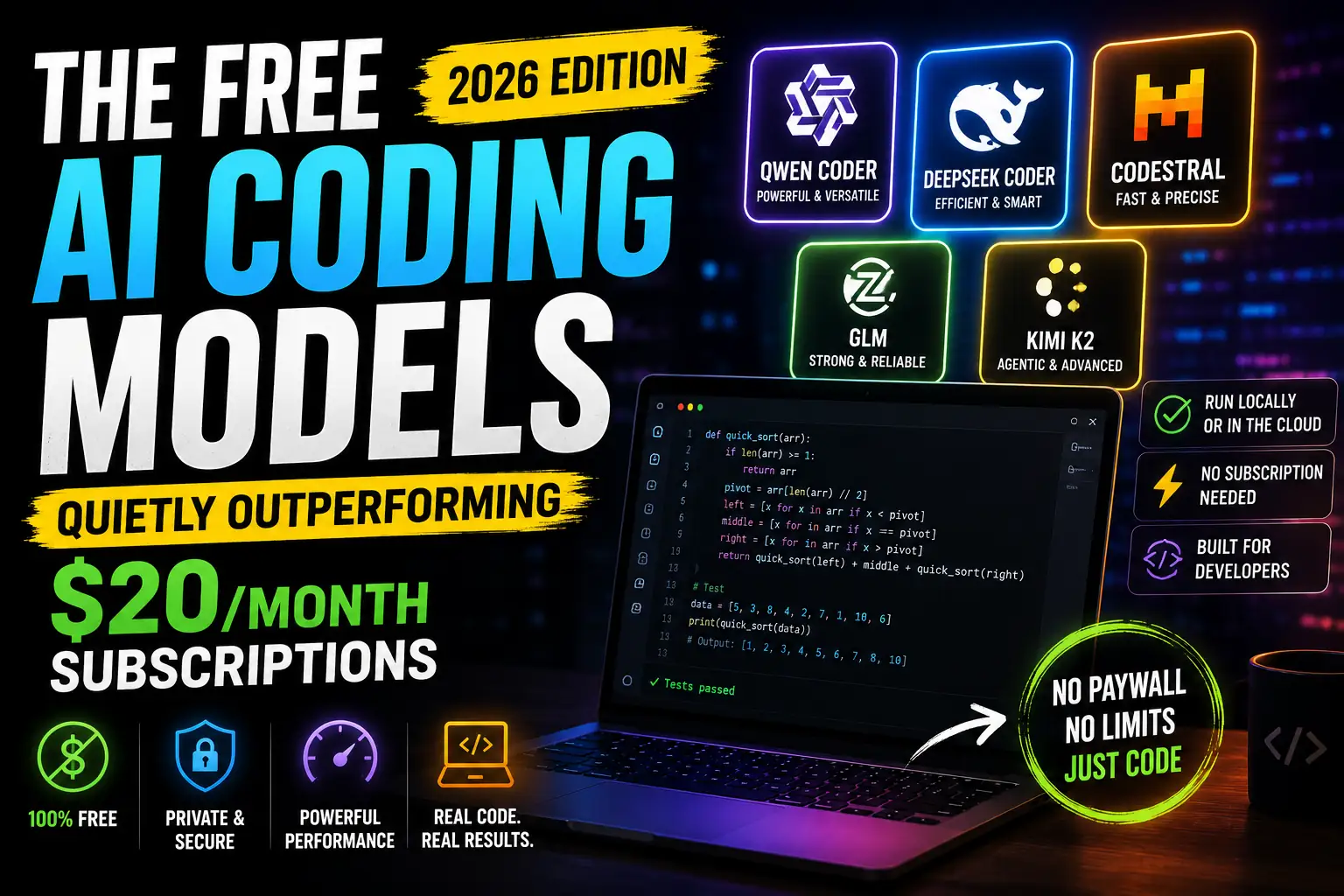
The Free AI Coding Models Quietly Outperforming $20/Month Subscriptions
Picture a developer named Tariq. He's freelancing from a small apartment, and a $20-a-month coding subscription isn't a rounding error to him — it's a real chunk of his monthly budget. For months he assumed AI-assisted coding simply wasn't for people like him. Then a friend sent him one sentence: "Just run Qwen Coder locally, it's free, no card needed."
Twenty minutes and one download later, Tariq had a cutting-edge coding model running locally on his own laptop. It was actively writing functions, catching bugs, and explaining unfamiliar code — completely without a subscription, a login, or a single dollar leaving his bank account.
That's the story most "best AI tools" articles conveniently skip. They talk about corporate products and monthly software-as-a-service (SaaS) fees. This article talks about the actual engines underneath — the open-weight models doing the heavy thinking, and the real, no-asterisk ways to use them in 2026.
So here's the question worth asking before you reach for your wallet: are you actually paying for better code, or are you just paying for convenience wrapped around an engine you could run for free? Let's find out.
Why "Free Model" Means Three Different Things
Imagine three distinct ways to get your morning cup of coffee. You could buy the beans and grind them yourself at home — giving you full control and zero ongoing cost, but you need the baseline equipment. You could walk into a local café that gives away a free small black coffee with a strict daily limit — highly convenient, no equipment required, but capped. Or you could just ask a coworker who already has a fresh pot brewing — instant, free, but you're completely stuck with whatever blend they decided to make.
Free AI coding models work in the exact same way, and conflating these three paths is where most developer confusion starts in 2026.
Lane One: Open-Weight Models You Run Yourself. These are real, downloadable models — not trial versions, not watered-down demos — released under highly permissive open licenses like Apache 2.0 or MIT. Families like Qwen Coder, DeepSeek, Codestral, GLM, and Kimi K2 publish their actual architectural weights publicly. Run them with a free local tool like Ollama or LM Studio, and the model lives entirely on your hardware. This means no rate limits, no internet dependency once downloaded, and absolutely no external company watching what you type into your terminal.
Lane Two: Free API Access to Hosted Models. Major providers like Google AI Studio, Groq, and developer aggregators like OpenRouter let you call real, capable models through an API key at no cost. These services are usually subsidised with a generous daily request cap or a "deprioritized during peak traffic hours" catch. This is the café's free-coffee lane: genuinely free, genuinely premium model performance, just not entirely unlimited.
Lane Three: Free Chat Interfaces. Platforms like ChatGPT, Claude.ai, and Gemini all offer default free tiers where you can quickly paste in a isolated function and ask "why is this breaking?" without installing a single package. It is the fastest on-ramp with the smallest learning curve, but you are typically routed to a lighter, less capable model than the paid flagship tier, and these interfaces are rarely built for the multi-file, repo-aware workflows that serious software engineering projects demand.
Lane One, Up Close: The Models You Actually Own
Here's where developer ecosystems get genuinely exciting. A few years ago, choosing a "free coding model" meant accepting something noticeably worse than the paid alternative — a massive downgrade you accepted purely out of financial necessity. In 2026, that gap has narrowed dramatically.
Open-weight model families have gone from "usable in a pinch" to "the daily driver for a meaningful share of working software engineers," especially for core tasks like writing boilerplate functions, refactoring legacy classes, or explaining a massive, unfamiliar codebase.
A few powerful names dominate the local landscape right now:
- Qwen Coder (from Alibaba): Widely regarded as one of the absolute strongest fully open, coding-focused families. It ships in multiple sizes, meaning it can scale down to run smoothly on a modest gaming laptop or scale up to rival much larger commercial models on public coding benchmarks.
- DeepSeek Coder: These models pair exceptional multi-step reasoning with a highly efficient Mixture-of-Experts (MoE) architecture. They activate only a tiny fraction of their total parameters per request, making them incredibly fast to execute on consumer-grade local hardware.
- Codestral (from Mistral AI): Fast, lightweight, and tuned explicitly for raw code completion. It remains a massive developer favorite for low-latency, in-editor inline autocomplete rather than long, conversational chat debugging.
- GLM and Kimi K2: Emerging powerhouses from top-tier labs that have put up fiercely competitive scores on agentic coding benchmarks — the grueling evaluations that test whether an AI can work through a multi-step, multi-file engineering task entirely on its own, rather than just answering a single trivia question correctly.
A fair warning belongs right here: benchmark leaderboards in this space reshuffle almost monthly, with a new "open-weight #1" announced every few weeks. Treat any specific score you see on social media as a brief snapshot of a single moment, not a permanent crown.
It is also vital to understand what "open-weight" actually promises and what it doesn't. Open-weight means the lab published the compiled model binary for you to download and run freely — it does not automatically mean the underlying training datasets are public. That distinction rarely impacts your day-to-day coding, but it matters if you are auditing a model for a highly regulated industry. Either way, the practical upside remains unmatched: you can point these models at your proprietary codebase, on your own hardware, with total peace of mind that zero data is leaving your local machine.
A Tale of Two Setups
Let's ground this technical shift with two short, very different real-world developer approaches.
Amara, a computer science university student, has an older laptop with 16GB of RAM and no dedicated GPU. She doesn't need an enterprise AI model capable of architecting a global microservices platform; she needs an assistant that explains complex recursion clearly and catches tricky off-by-one errors in her data structures homework. A mid-sized open-weight coder model, run locally via Ollama, handles that comfortably. Best of all, it runs just as flawlessly on a commuter train with zero Wi-Fi as it does at her kitchen table.
Devon, meanwhile, is solo-bootstrapping a tech startup and writing a genuinely complex backend with dozens of interacting API microservices. He doesn't have the high-end hardware budget required to self-host a massive, frontier-scale local model. Instead, he leans strategically on a free-tier API key through an aggregator like OpenRouter, effortlessly rotating between a couple of free hosted models depending on which one is most responsive that day. It isn't completely unlimited — he has learned to expect occasional latency spikes when global traffic peaks — but for a pre-revenue founder, "occasionally slow" easily beats "another recurring monthly bill."
Same general need — writing and understanding software with deep AI assistance — but a completely different shape of solution. Hardware capacity, internet reliability, and overall project complexity decided their ideal lane, not flashy corporate brand loyalty.
The Honest Catch (Because Every Free Thing Has One)
Let's not pretend this open-source ecosystem is a free lunch with absolutely no fine print, because it isn't.
Free, self-hosted local models trade raw ceiling capabilities for zero ongoing financial cost. The very best closed, paid frontier models still hold a slight edge on the absolute hardest engineering problems — ambiguous architectural decisions, legacy monolith migrations, and tasks that require maintaining an immense codebase context window in memory simultaneously. The gap has shrunk to the point where 90% of everyday coding work won't notice the difference, but the ceiling hasn't vanished entirely.
Free API tiers come with strict rate limits and deprioritized infrastructure queues. This means your terminal requests might wait in line behind paying enterprise customers during high-volume business hours. That is a real operational cost, just measured in developer patience instead of raw dollars.
Finally, software licensing matters far more than people assume. While Apache 2.0 and MIT licenses generally permit full commercial use, "generally" is not a blanket guarantee. If you are shipping a commercial product, it is well worth taking five minutes to verify the exact license attached to your specific model version rather than blindly assuming every "open" model shares identical terms.
A Quick Decision Framework
If you're standing at the fork in the road wondering which path matches your current setup, ask yourself these three simple questions:
- Do I have decent hardware and care deeply about data privacy or offline access? → Self-host an open-weight model family using Ollama or LM Studio.
- Am I quickly prototyping a side project, or do I just not want to mess with local hardware configurations? → Grab a free API tier from Google AI Studio, Groq, or OpenRouter.
- Do I just need quick, occasional answers without installing any local developer tools? → A web-based free chat interface is your lowest-friction option — just keep in mind you are getting a lighter, less context-aware model version.
There's absolutely no shame in blending these approaches. Plenty of modern developers self-host lightweight models for local inline autocomplete and keep a free cloud API key on standby for heavier conversational debugging sessions.
A Feedback Loop, Before You Commit
Before you completely rebuild your development workflow around a specific free model, run this rapid, 30-second gut-check:
- Relevance: Does this model actually excel at the specific programming languages and frameworks I use most days, or did I pick it purely because it topped a benchmark graph I saw on X?
- Readability: When it explains its architectural reasoning, do I actually learn from it, or am I just blindly copy-pasting its output and hoping it compiles?
- Impact: If I switched back to writing this code entirely by hand tomorrow morning, would I lose measurable development time, or would I barely notice the difference?
If a model fails that basic check, it's not a failure on your part — it's a clear signal to pivot and test the next open option. With this many free, genuinely capable options available to developers in 2026, there is zero reason to force a tool that isn't naturally working for your stack.
The Real Takeaway
Tariq, from the start of our piece, never did buy that $20/month subscription. He simply didn't need to. The raw model doing his actual logical thinking was open and free the entire time — he just hadn't been pointed toward the right setup guide yet.
That's the quiet truth underneath most noisy "best AI coding tool" marketing debates: a massive percentage of raw machine intelligence in 2026 has become a free commodity.
What you are actually paying for with premium commercial platforms is the sleek packaging around that intelligence — the visual UI polish, the IDE integrations, and the infrastructure convenience. Sometimes that premium packaging is well worth paying for. But it's worth knowing, clearly and honestly, when you can easily get the exact same engine for free.
Sources & Further Reading
- Ollama, Official Local Model Library
- Hugging Face, Open Weight Model Hub & Inference Services
- aimadetools.com, "10 Best Free AI Coding Models in 2026"
- aimadetools.com, "Best AI Models for Coding Locally — 2026 Ranking"
- Kilo, "Best Open-Source & Open-Weight Coding Models (2026)"
- NxCode, "7 Best Free AI Coding Tools (2026)"
- Remote OpenClaw, "Best Free AI Models in 2026"
- ShaikhWarsi, Curated GitHub Repository of Free AI Tools & APIs
Comments
0 comments
No comments yet
Start the discussion with a thoughtful note.