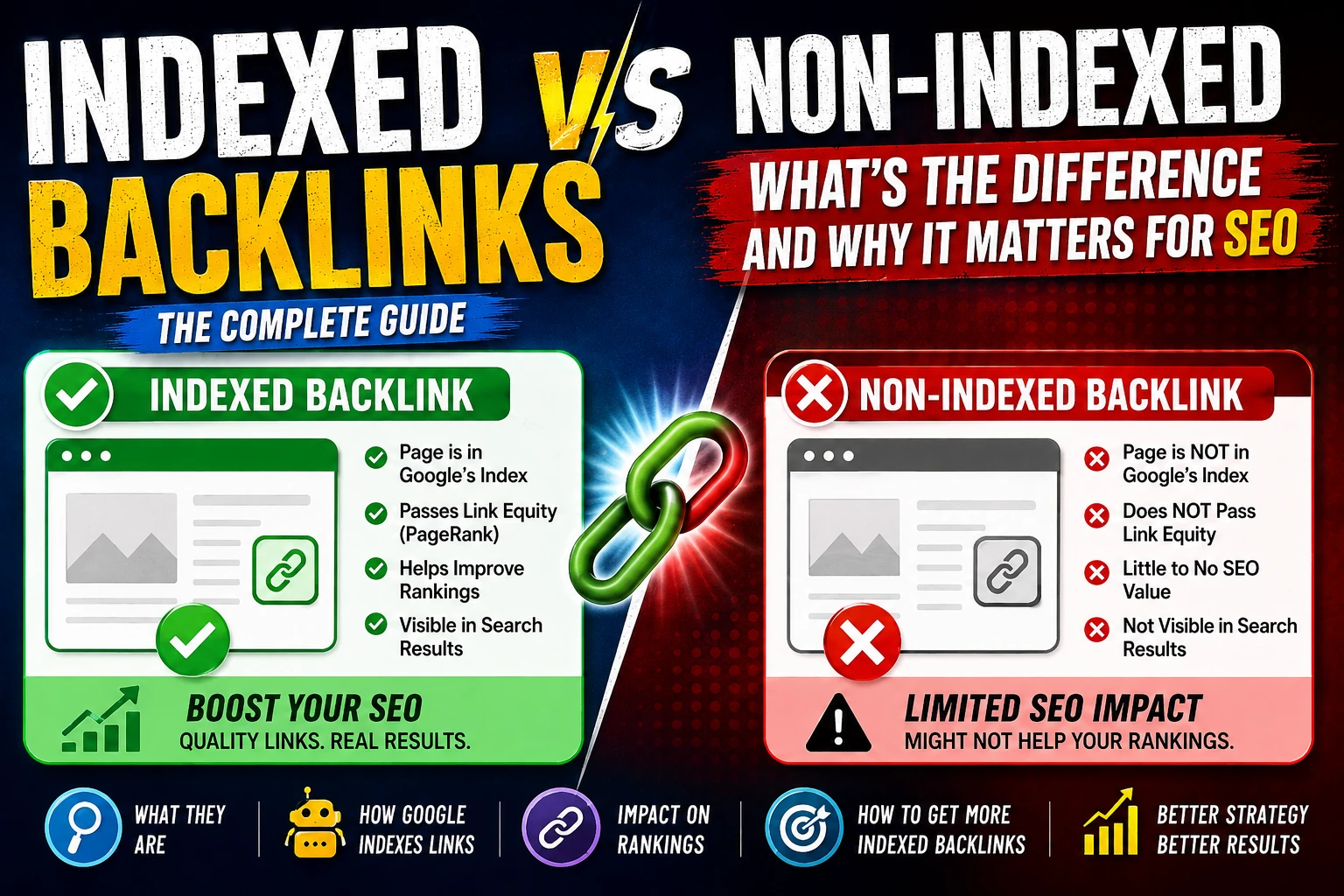
Indexed vs Non-Indexed Backlinks: What's the Difference and Why It Matters for SEO
Welcome to a comprehensive guide that cuts through the confusion about indexed vs non-indexed backlinks. If you've been working in SEO for any period, you've likely encountered situations where some of your hard-earned backlinks simply don't seem to be contributing to your rankings as expected. The mystery often lies in whether those backlinks are from indexed or non-indexed pages.
In this article, we'll break down exactly what indexed and non-indexed backlinks are, how Google discovers and indexes them, and why this distinction can make or break your SEO strategy. Whether you're managing SEO for a blog, eCommerce store, SaaS company, or agency client, understanding this fundamental concept is crucial for building a robust backlink profile that actually drives results.
What Is a Backlink?
Before diving into the indexed vs non-indexed distinction, let's establish the basics. A backlink (also called an inbound link, incoming link, or outbound link from the linking site's perspective) is any hyperlink from one website to another.
Backlinks form the foundation of Google's PageRank algorithm and remain one of the most valuable SEO assets you can acquire. They serve two primary purposes:
- User Navigation: Help visitors discover related content and resources
- Search Engine Ranking: Signal to Google that your content is valuable and trustworthy
What Is an Indexed Backlink?
An indexed backlink is a backlink from a page that Google has crawled and included in its index. Think of Google's index as a massive library catalog—only books (pages) that have been cataloged are searchable and usable for ranking purposes.
When a page containing your backlink is indexed, it becomes part of the searchable universe that Google can use to evaluate link equity and relevance. This is crucial because Google's algorithms can only consider links from pages they know exist.
Here are the key characteristics of indexed backlinks:
- Originating from pages Google has crawled and stored
- Available through Google's site:operator or link:operator
- Capable of passing link equity (PageRank) to your page
- Often contributing to search rankings
What Is a Non-Indexed Backlink?
A non-indexed backlink (also called unindexed or non-crawled backlink) comes from a page that Google has encountered but decided not to include in its index. This could happen for various reasons, from technical issues to deliberate de-indexing decisions.
Non-indexed backlinks exist in a kind of "digital shadow realm"—Google is aware of their existence but simply chooses not to make them part of its searchable database. This creates a significant limitation for SEO value, as Google cannot effectively use these links for ranking purposes.
Common examples of non-indexed backlinks include:
- Pages behind password protection or login walls
- Pages with crawl errors or server issues
- Pages explicitly blocked via robots.txt or noindex tags
- Pages with duplicate content issues
- Pages that Google considers low-quality or spam
How Google Discovers and Indexes Backlinks
Understanding Google's discovery and indexing process is essential for grasping why some backlinks end up indexed while others don't. Here's the technical breakdown:
- Crawling: Google's bots (Googlebot) follow existing links across the web, discovering new pages and updating their knowledge of existing ones.
- Evaluation: When Google encounters a page, it evaluates multiple factors to determine whether to index it.
- Indexing: If the page passes evaluation, Google stores it in its index for future search queries.
- Linking Analysis: During this process, Google analyzes all outgoing and incoming links on the page.
It's important to understand that Google doesn't create a separate index for individual backlinks. Instead, the page containing the backlink gets indexed, and the backlink itself becomes part of that indexed page's content.
Key Insight: A backlink itself is not indexed independently; the page containing the backlink is what search engines crawl and index.
Comparison: Indexed vs Non-Indexed Backlinks
| Aspect | Indexed Backlinks | Non-Indexed Backlinks |
|---|---|---|
| SEO Value | High - actively contribute to rankings | Low/None - cannot influence rankings |
| Crawl Status | Crawled and included in Google's index | Not included in Google's index (though Google may know of its existence) |
| Link Equity | Can Pass - transfers PageRank and authority | Cannot Pass - Google's algorithms ignore it |
| Visibility | Visible through Google's search results and link operators | Not visible through standard Google searches |
| Ranking Impact | Direct - can improve rankings on target page | Indirect - provides no direct ranking benefit |
| How to Verify | Check via Google Search Console, site:operator, or third-party tools | Difficult to verify definitively; may show as "not found" in searches |
Why Indexed Backlinks Are Important for SEO
The importance of indexed backlinks cannot be overstated. Let's examine why these backlinks are crucial for your SEO strategy:
1. Link Equity Transfer
Indexed backlinks are the only types that can pass link equity from the linking page to your target page. This transfer of "ranking power" is fundamental to how Google's algorithm evaluates page authority.
2. Search Visibility
When Google indexes a page containing your backlink, that page becomes visible in search results. This increases the chances that users will discover your content through organic search, potentially leading to additional backlinks.
3. Trust and Authority Signals
Google interprets indexed backlinks as stronger trust signals because they come from pages that Google has thoroughly evaluated and deemed worthy of inclusion in its index. This can significantly enhance your page's perceived authority.
4. Competitor Analysis Advantage
Understanding which of your competitors' backlinks are indexed versus non-indexed can provide strategic insights into where to focus your acquisition efforts for maximum impact.
Can Non-Indexed Backlinks Still Provide Value?
While non-indexed backlinks have limited direct SEO value, they can still provide some indirect benefits:
- User Traffic: Visitors from the linking site can still find their way to your content through direct navigation.
- Referral Analytics: You can still track referral traffic in Google Analytics.
- Brand Exposure: Increased visibility of your brand across the web.
- Potential for Future Indexing: If the linking page improves and gets indexed, the backlink may become valuable later.
Reality Check: Most SEO professionals would agree that non-indexed backlinks should be viewed as "backup assets" rather than primary SEO drivers.
Common Reasons Backlinks Remain Non-Indexed
Understanding why backlinks remain non-indexed can help you avoid similar issues with your linking strategies. Here are the most common reasons:
Technical Barriers
- Crawl Errors: 404, 500, or other server errors on the linking page
- Robots.txt Blocks: Pages explicitly blocked from crawling
- Meta Tags: Noindex tags preventing indexing
- Canonical Issues: Duplicate content with canonical tags pointing elsewhere
Content Quality Issues
- Thin Content: Pages with insufficient unique content
- Low E-A-T: Pages with poor Expertise, Authority, or Trustworthiness
- Spammy Signals: Content that appears manipulative or spammy
- Age: Very new pages that haven't established credibility
Structural Problems
- Poor Internal Linking: Pages disconnected from site structure
- Broken Links: Links to pages that no longer exist
- Page Speed: Slow-loading pages that discourage crawling
- Mobile Issues: Poor mobile experience causing Google to de-prioritize
How to Check If a Backlink Is Indexed
Determining whether a specific backlink is indexed can be done through several methods:
Simple Verification Methods
- Google Search: `site:linkingdomain.com` - Check if the domain appears in Google's index
- Link: Operator: `link:yoursite.com` - See which pages link to your site
- Google Search Console: Check Coverage Report for indexing status
Advanced Tools and Techniques
- Ahrefs/Semrush Majestic: Check backlink profiles and indexing status
- Screaming Frog SEO Spider: Analyze crawl data and linking pages
- Sitebulb: comprehensive site audit showing indexing status
- Bing Webmaster Tools: Bing's index view as a secondary verification source
Pro Tip: Regularly monitoring the indexing status of your backlink sources helps identify patterns and allows you to reach out to site owners about potential crawl issues.
Ways to Improve Backlink Indexing Chances
While you cannot guarantee that specific backlinks will be indexed, there are strategies to improve the likelihood:
For Link Acquisition
- Quality Over Quantity: Focus on securing backlinks from high-authority, well-indexed sites
- Relevant Contexts: Ensure your backlink appears in content relevant to your niche
- Fresh Content: Link to sites with regularly updated, valuable content
- Proper Attribution: Include relevant anchor text and context
Technical Optimization
- Fix Linking Page Issues: Ensure pages linking to you have good technical health
- Improve Internal Structure: Help linking pages establish context through strong internal linking
- Monitor Backlink Sources: Keep track of where your backlinks come from and address issues promptly
- Content Enhancement: Add valuable content to pages linking to you to encourage re-crawling
Common Myths About Indexed vs Non-Indexed Backlinks
SEO is full of myths, and backlink indexing is no exception. Let's debunk some of the most common misconceptions:
Myth 1: All High-DA Links Are Automatically Indexed
Fact: Domain authority doesn't guarantee indexing. Content quality, relevance, and Google's evaluation criteria matter more.
Myth 2: If Google Knows About It, It Must Be Indexed
Fact: Google can discover pages without including them in its index. Discovery ≠ indexing.
Myth 3: Non-Indexed Links Always Mean Something Is Wrong
Fact: Sometimes non-indexed backlinks are expected (e.g., login pages, admin areas). Not all pages should or need to be indexed.
Myth 4: Indexed Backlinks Always Improve Rankings
Fact: Indexing is necessary but not sufficient for ranking. Relevance, content quality, and many other factors also matter.
Myth 5: You Can Force Indexing of Any Backlink
Fact: While you can request indexing via Google Search Console, it doesn't guarantee results. Google's evaluation process is automated and comprehensive.
Common Mistakes to Avoid
Avoiding common pitfalls can save you time and frustration in your backlink strategies:
Mistake 1: Ignoring Broken or Redirected Links
Don't assume a backlink is working correctly. Always verify that the linking page exists and hasn't moved.
Mistake 2: Overvaluing Non-Indexed Links
Don't count non-indexed backlinks in your SEO ROI calculations. They don't contribute to rankings.
Mistake 3: Not Monitoring Linking Pages
Links can disappear or get de-indexed without notice. Regular monitoring is essential.
Mistake 4: Assuming All Free Directories Are Valuable
Many free directories have poor indexing rates or low-quality pages, making their backlinks less valuable.
Mistake 5: Neglecting Anchor Text Relevance
Even indexed backlinks from irrelevant contexts provide less value than those from relevant, natural placements.
Frequently Asked Questions
Q: How do I know if a specific backlink is causing issues for my site?
A: Use Google Search Console's Manual Actions, Disavow Tool, and check if link removals correlate with ranking changes.
Q: Should I disavow non-indexed backlinks that are low-quality?
A: It's generally unnecessary for non-indexed backlinks since they don't pass link equity. Focus disavowal on harmful, indexed links instead.
Q: Can I get penalized for having non-indexed backlinks?
A: Generally no, since non-indexed backlinks don't pass link equity or appear in search results. However, if they stem from spammy practices on the linking page, your site could be affected.
Q: How long does it take for a backlink to become indexed after acquisition?
A: This varies widely. New pages might take weeks to months. It depends on the linking page's authority, content quality, and Google's crawling schedule.
Q: Does the position of a backlink on a page affect indexing?
A: While positioning doesn't directly affect indexing, backlinks in main content tend to be more valuable than those in footers or sidebars.
Final Verdict
Understanding the difference between indexed and non-indexed backlinks is fundamental to any effective SEO strategy. While both types can provide some value, indexed backlinks remain the true workhorses of your backlink profile.
Focus your efforts on acquiring high-quality backlinks from well-indexed, authoritative sites. Monitor your backlink profile regularly to ensure you're maintaining a healthy ratio of indexed to non-indexed links.
Remember that backlink building is a marathon, not a sprint. Quality, relevance, and natural growth should always trump quantity when building a sustainable SEO foundation.
Key Takeaways
- Indexed backlinks come from pages Google has crawled and included in its index, while non-indexed backlinks come from pages Google has not indexed.
- Only indexed backlinks can pass link equity and directly influence rankings.
- Non-indexed backlinks may still provide user traffic and brand exposure but have minimal SEO value.
- Regular monitoring and quality focus are essential for maintaining a healthy backlink profile.
- Technical health, content quality, and authority all play crucial roles in whether backlinks get indexed.
- Force important backlink pages to get crawled and indexed by ensuring they have strong internal linking and quality content.
References
- Google Search Central - SEO Starter Guide
- Google - How Search Works
- Google Developers - Crawling and Indexing
- Google Search Console Help
- Ahrefs - Link Building SEO Guide
- Semrush - Backlink Guide
- Moz - Link Building
- Search Engine Journal - Complete Guide to Backlinks
- Search Engine Land - Google Backlink Indexing Insights
- Backlinko - On-Page SEO Factors
- Bing Webmaster Guidelines
Comments
0 comments
No comments yet
Start the discussion with a thoughtful note.